

What is Class 4 Laser Therapy?
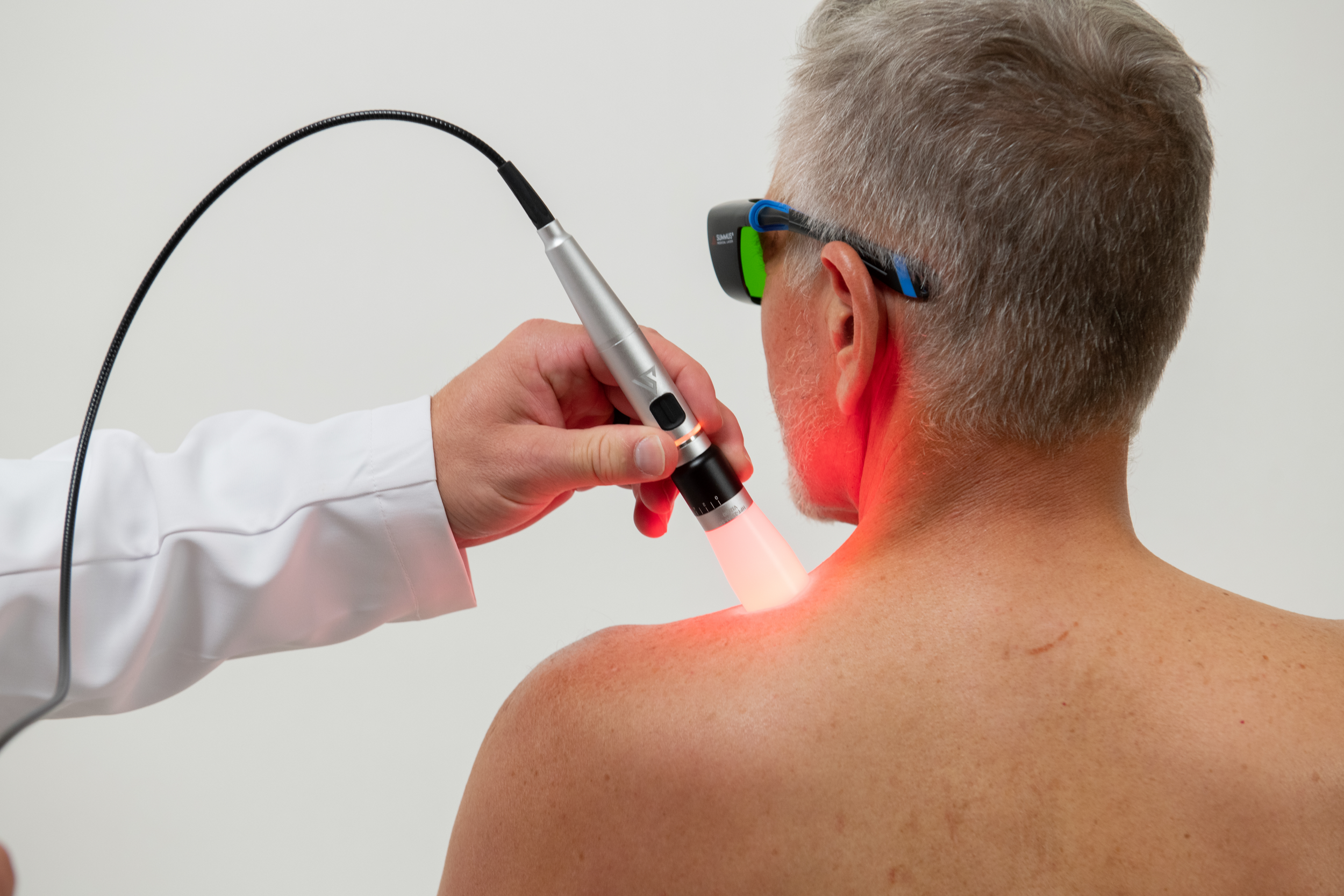
Class 4 laser therapy is, by definition, an attended clinical procedure in which a trained clinician or laser technician actively delivers photonic energy to a defined volume of tissue, sequencing treatment from proximal neurological and vascular control centers to distal targets while continuously managing dose, orientation, contact, and patient response.
Static unattended delivery does not meet this definition.
See: Pitfalls and Errors of Unattended Static Laser Treatments
It must treat a large volume of tissue.
Therapeutic photobiomodulation depends on delivering adequate photon density across the full anatomical target-muscle bellies, fascial planes, vascular beds, and regional lymphatic basins-not a single hand-sized spot. Covering that volume requires a clinician to actively move the treatment wand across the tissue. A statically held or side-to-side "wiggling" beam illuminates only a fraction of the relevant tissue and cannot achieve regional coverage.
Proximal-to-distal sequencing is impossible without active delivery.
The core treatment philosophy requires treating proximal control centers first, then tracing distally along the nerve and vascular pathway in a deliberate order. This sequencing - cervical spine beforehand, lumbar roots before foot - governs the entire therapeutic effect and can only be executed by an operator moving through anatomical regions in the correct sequence.
Nerve function is influenced by tracing the nerve's course.
Following a nerve from its root, along its anatomical path, to the symptomatic endpoint requires continuous, guided motion. This is a defining feature of the modality and cannot be reproduced by a device fixed over one region.
Beam orientation and depth must be adjusted in real time.
Maintaining perpendicular beam orientation and compensating for varying tissue depth across a contoured body region requires a human operator. Fixed devices sit at suboptimal angles, losing dose to scatter and failing to reach the tissues that matter.
Contact and pressure affect penetration.
Consistent skin contact and appropriate contact pressure meaningfully improve photon penetration. This requires a hand on the wand; a suspended or hovering beam loses penetration and delivers uneven energy.
Real-time clinical judgment and reassessment are integral.
Selecting correct tissue targets, adjusting for patient tolerance and feedback, and covering all relevant contributors-not just where it hurts-are decisions made moment-to-moment during delivery. This is the difference between treating the source and treating only the symptom.
Spinal segments and nerve roots must be deliberately targeted.
The dorsal root ganglion, nerve roots, paraspinal tissues, and sympathetic chain are deep, precisely located targets that sit away from the site of symptoms. Reaching them requires intentional positioning over specific spinal levels, appropriate angulation, depth compensation, and slow overlapping passes-none of which a fixed or oscillating device can perform. Modulating these control centers is what interrupts upstream nociceptive and inflammatory signaling.
Circulatory effects depend on the direction and order of treatment.
Priming arterial blood entering a limb with an anti-inflammatory signal, before irradiating distal tissue, requires the clinician to work proximal structures first and then progress distally. A static beam on the symptomatic site primarily influences venous blood and forfeits the systemic, arterial-priming effect that makes the treatment coherent and system-wide.
Lymphatic drainage requires opening proximal basins first.
Reducing edema depends on treating proximal drainage regions-inguinal, axillary, supraclavicular-before the swollen tissue, using broad sweeping or spiral motion over large surface areas. Treating distal swelling in isolation risks trapping fluid. Only an attendant can sequence and sweep the drainage pathways appropriately.
Thermal safety and therapeutic dose depend on continuous motion.
At Class 4 power levels, delivering an effective energy density while keeping tissue temperature safe depends on constant movement and real-time adjustment. Static delivery risks thermal injury on one hand or sub-therapeutic dosing on the other.
Patient movement must be accommodated-and used.
Patients shift during treatment; without an operator, the beam drifts off target. Active delivery also allows the clinician to have the patient move the joint or body part during irradiation, leveraging enhanced blood flow and reduced tissue tone-an intentional therapeutic technique unavailable to unattended systems.
Safety and liability require a clinician present.
Leaving a patient alone with an operating Class 4 laser is clinically and medico-legally indefensible. Eye-exposure risk is real, and an unattended treatment is difficult to defend if an adverse claim arises.
Class 4 Laser Therapy (n.) - A clinician-attended therapeutic procedure in which a trained clinician or laser technician actively delivers Class 4 photonic energy to the patient by moving the treatment emitter across a defined volume of tissue. Effective treatment requires active delivery because the modality's therapeutic effects are regional and system-dependent rather than confined to a single point: energy must be applied across a sufficient volume of tissue-including muscle, fascia, vascular beds, and lymphatic drainage basins-and sequenced from proximal neurological and vascular control centers (spinal segments, nerve roots, dorsal root ganglia, and the sympathetic chain) to distal targets, so as to influence circulation, lymphatic flow, and nerve function along their anatomical course. Throughout delivery, the operator continuously manages energy density, beam orientation, tissue-depth compensation, contact pressure, thermal safety, and real-time patient response.
By definition: Class 4 laser therapy is an attended modality.
Attended Delivery (n.) - The active, clinician-guided application of Class 4 laser energy, characterized by continuous emitter motion, deliberate anatomical targeting, proximal-to-distal sequencing, maintained skin contact, and real-time adjustment to patient feedback. Attended delivery is a defining requirement of Class 4 laser therapy, not an optional technique.
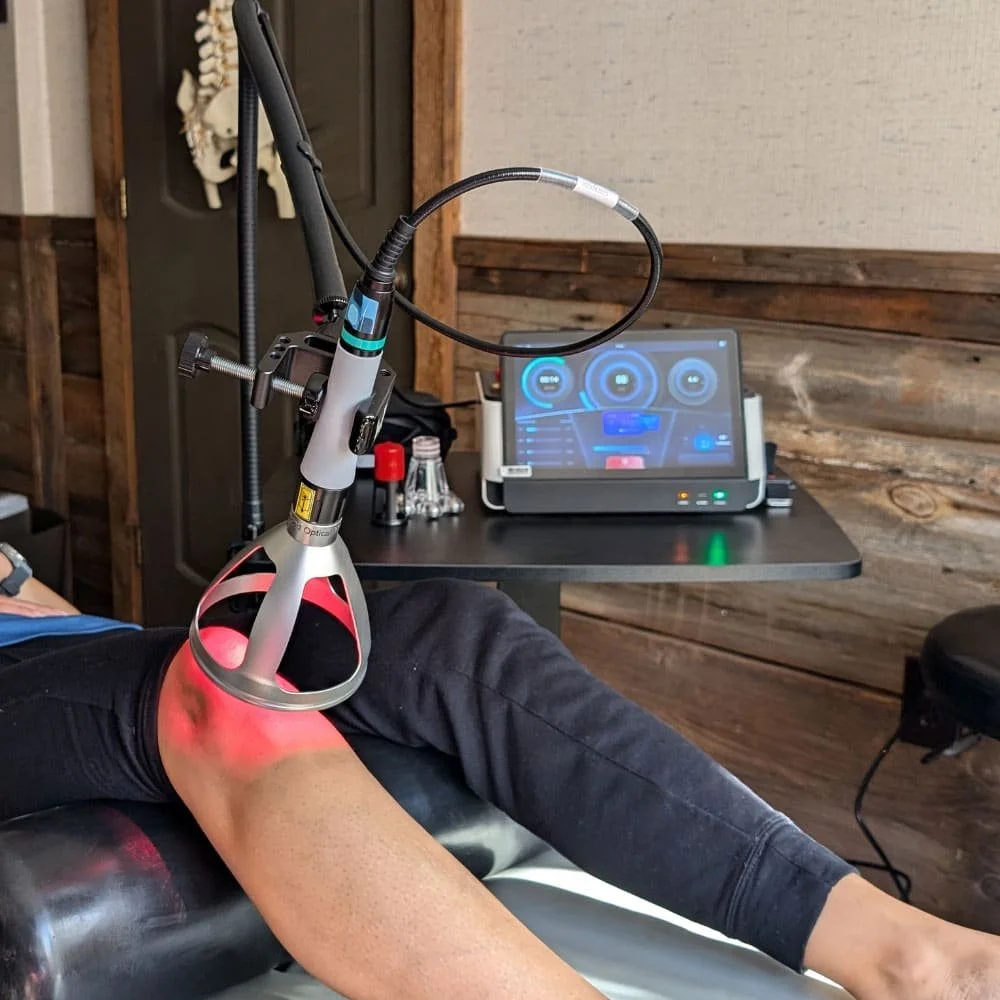
Unattended Delivery (n.) - The static or mechanically oscillating application of Class 4 laser energy to a fixed, localized area without an operator actively guiding the emitter-for example, a treatment wand held stationary on a stand, or a device that articulates the emitter side-to-side over a small region. Unattended delivery cannot achieve regional tissue coverage, proximal-to-distal sequencing, real-time dose and orientation control, or the neurological and circulatory effects that define Class 4 laser therapy and introduces unacceptable safety and liability exposure. Unattended delivery does not meet the definition of Class 4 laser therapy.
Pitfalls and Errors of Unattended Static Laser Therapy
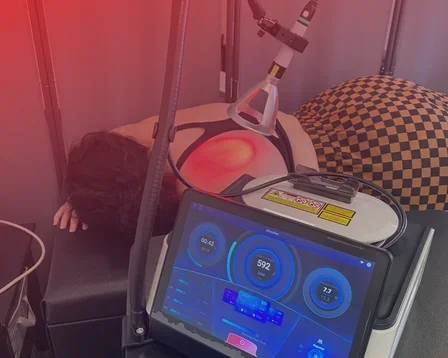
Power must be reduced to avoid burns, which sacrifices efficacy. Because a static beam dwells on one spot, heat accumulates in that fixed area. To keep unattended delivery "safe," power must be dropped well below what a moving Class 4 beam can safely deliver. The result is a self-defeating trade-off: low enough power to sit still, but often too low to reach therapeutic thresholds in the target tissue. The clinic pays for a Class 4 device and delivers a low-level dose.
Real risk of patient burns-and the malpractice/liability exposure that follows. A high-power beam held stationary on tissue (image 1's foot, image 3's knee) can accumulate enough thermal energy to cause a burn, particularly over bony prominences, superficial nerves, or areas with reduced sensation. With no operator monitoring skin response in real time, an injury can progress before anyone intervenes. An unattended burn is difficult to defend to a malpractice carrier or board-there was no clinician present, no real-time monitoring, and no documented response.
Dose is lost to scatter when the beam strikes tissue at an angle. The foot, ankle, and knee are curved surfaces. In these images the beam meets the tissue obliquely rather than perpendicularly, so a significant fraction of the energy is reflected and scattered off the surface (Fresnel reflection increases sharply at non-perpendicular incidence). A clinician actively delivering the beam constantly re-orients to maintain perpendicular contact; a clamped or gooseneck-mounted emitter cannot. The "dose" leaving the emitter is not the dose absorbed.
The patient can move the body part out of the static beam. None of these limbs are immobilized. A small shift of the foot or knee moves the target off the fixed beam entirely-so the tissue receives a partial dose, no dose, or the beam lands on unintended tissue. Treatment time continues to elapse while little or nothing therapeutic is being delivered.
Serious laser-safety concerns with no operator present. A Class 4 beam is a Class 4 hazard whether or not anyone is watching it. If the patient reaches toward the emitter, repositions, or the beam reflects off skin, jewelry, or the treatment head, there is an ocular hazard with no one positioned to shut off the device or enforce protective eyewear. Leaving an operating Class 4 laser unattended removes the single most important safety control-an attentive operator.
Only a small, fixed area is treated-no regional coverage. Class 4 therapy depends on covering a volume of tissue (muscle, fascia, vascular beds, lymphatic basins). A stationary head illuminates one hand-sized patch. The surrounding tissue that should be treated is simply missed.
Proximal-to-distal sequencing is impossible. A fixed emitter parked over the symptomatic site (the ankle, the "tennis elbow") cannot treat proximal nerve roots, spinal segments, or vascular pathways first, then trace distally. The entire neurologic and circulatory rationale of the treatment is forfeited; the device only ever addresses "where it hurts."
Non-contact, off-the-skin delivery loses penetration. The gooseneck and clamp setups hold the emitter in the air, off the tissue. Without skin contact and light contact pressure, more energy is lost to surface reflection and scatter and less reaches deep target tissue. Contact technique-applied by hand-meaningfully improves penetration.
No response to real-time patient feedback. An attending clinician adjusts to warmth, discomfort, and tissue response moment to moment. An unattended head cannot detect that the patient is feeling excessive heat or that a region has had enough-it delivers the same output regardless.
No incorporation of active joint movement. Part of skilled Class 4 delivery is having the patient move the joint during irradiation to leverage improved blood flow and tissue tone. A static beam and a still limb make this impossible.
Ethical and billing exposure from undelivered dose. Between angle scatter, air gap, patient drift, and reduced power, the tissue absorbs only a fraction of the nominal dose-yet the patient is charged for a full Class 4 treatment. This is difficult to defend on both documentation and ethical grounds.
Misrepresentation as a "robot" or "hands-free" advancement. A device that is clamped in place or wiggled by a mechanical arm is not automation or robotics in any meaningful clinical sense. Marketing static delivery as a technological upgrade misrepresents what is, functionally, an abandonment of active treatment.